
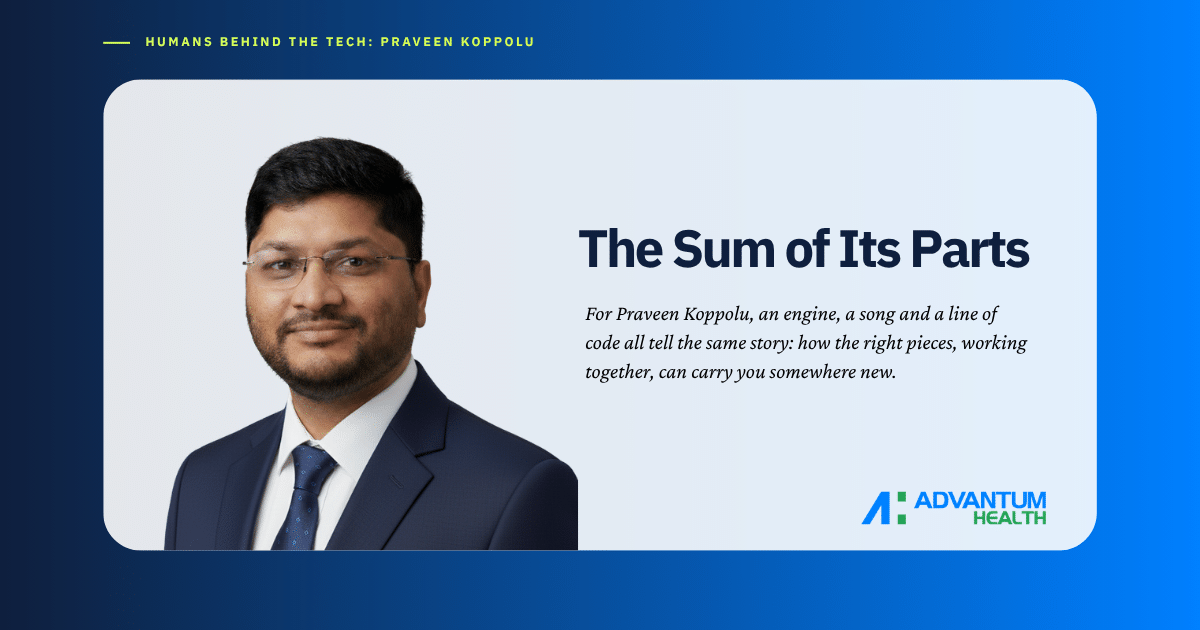
For Praveen Koppolu, an engine, a song and a line of code all tell the same story: how the right pieces, working together, can carry you somewhere new.
The first gift Praveen Koppolu remembers from his father was not a toy. It was a book on automobile engineering written by Henry Ford. Praveen was a boy then, growing up in a humble home in India, and the pages felt like a door swinging open. Around him were tools, the smell of grease and a motorcycle his father was forever coaxing back to life. Side by side, they would take an engine apart and put it together again, and Praveen learned to love the patient work of understanding how the pieces fit until the whole thing finally roared.
That curiosity never left him. Today, more than three decades later, Praveen serves as vice president of AI and engineering at Advantum Health, where he builds systems instead of engines. The instinct, though, is the same. He is still drawn to how individual parts, arranged with care, come together to make something powerful.
His path to healthcare did not run in a straight line. Praveen started in technology consulting, untangling business and data problems across industries, before moving deeper into healthcare and revenue cycle management. What pulled him in was the difficulty of the work. What kept him there was the meaning behind it.
“Healthcare is one of those industries where technology has to do more than automate tasks,” he said. The work in RCM often happens out of sight, but its outcomes reach providers, patients and the operational teams who carry real responsibility every day. If a system can make their work easier and more accurate, Praveen believes, it is doing something that matters.
He has carried a particular dream for a long time. About 12 years ago, he was building data pipelines and reporting systems, moving information from one place to another. The reports were tidy, but they rarely answered the questions people were truly asking.
“We had data, but not enough intelligence. We had reports, but not always insight.”
So he began to imagine a system where someone could simply ask a question in plain language and receive a meaningful, contextual answer in return. At the time, it felt distant. With today’s advances in AI, that vision is finally within reach, and Praveen finds himself building the very thing he once only pictured.
His approach is shaped less by technology than by the people who raised him. Praveen’s parents were his earliest mentors, and the lesson he returns to most often came from them: do not rush at a problem. Take a step back, think it through, stay humble and treat people with empathy. Growing up without an easy path taught him that progress comes from persistence and curiosity, and that you can build your own way forward as long as you keep solving the problem in front of you.
That grounding shows up in how he leads. Praveen does not believe a leader needs to have every answer. He sees the job as listening, guiding and creating an environment where people can do their best work, where teams feel supported but also inspired to take on hard problems, the kind that sit at the intersection of technology, strategy and imagination.
There is no shortage of hard problems in revenue cycle management. Payer rules, coding guidelines, documentation requirements and denial patterns shift constantly, and teams are asked to move quickly without sacrificing accuracy. Too often, Praveen said, problems surface only after the fact, after a denial or a costly delay. His aim is to help teams catch risk earlier and make better decisions before small issues become expensive ones. The future of RCM, in his view, is not simply automation. It is intelligence that understands context and supports human judgment rather than replacing it.
Away from his screens, Praveen keeps the same fascination alive in two ways. He owns five motorcycles, each with its own personality: a naked sportbike, a super sport, an adventure tourer, a scrambler and an off-roader. Riding helps him reset and reconnect with the journey rather than the destination. He is also an audiophile who hears music the way he reads a system, listening for the layers that combine into something whole, from Queen and The Beatles to Daft Punk and Gorillaz.
It is all the same pursuit, really. Whether he is studying an engine, a song or a piece of AI architecture, Praveen is searching for the moment when separate parts lock into place and begin to move together. At Advantum, he gets to chase that moment on behalf of the people healthcare too often forgets to make things easier for. “AI should not replace the human side of healthcare,” he said. “It should support it.” That, more than any machine, is the thing he most wants to build.