
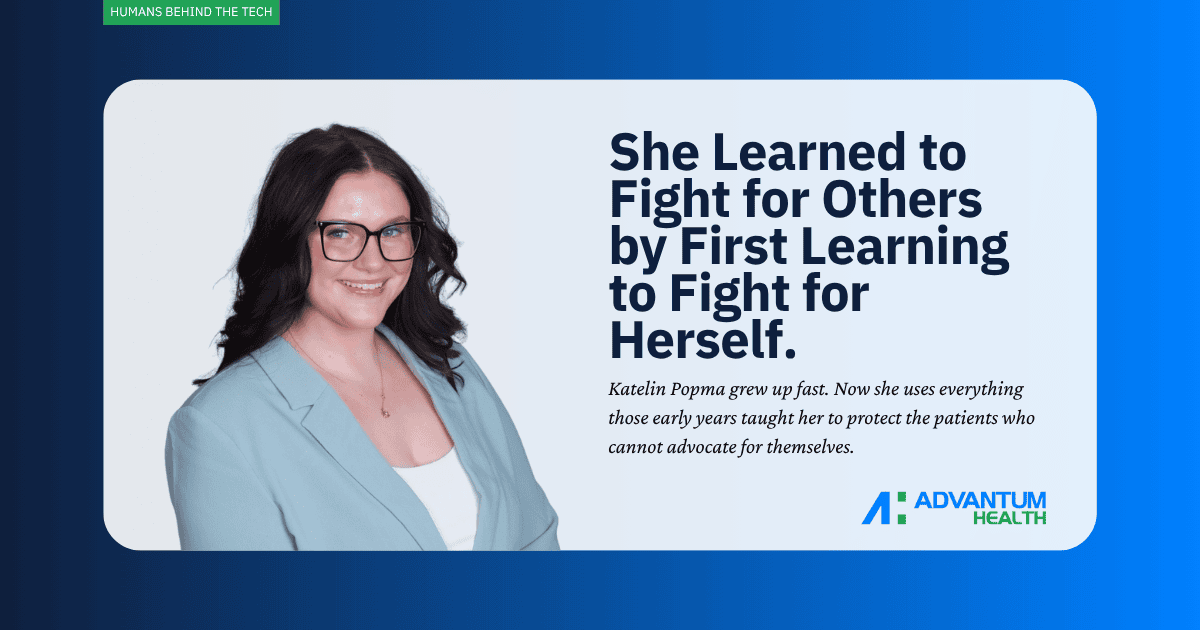
Katelin Popma grew up fast. Now she uses everything those early years taught her to protect the patients who cannot advocate for themselves.
Katelin Popma was 14 years old when she asked her mother for her own bank account and a job. Not because she had to, but because she already understood something most people take years to learn: that independence is something you build, one small act of ownership at a time.
Growing up as the oldest of seven children, Katelin had responsibilities before she had a resume. She helped raise her siblings, learned to navigate a busy household and absorbed early on that the people around you depend on the systems you put in place, whether or not those systems have a name.
Those childhood lessons had not yet found their professional form when, at 17, she took her first job as a hospital secretary. Then life handed her a crash course she never asked for.
A close loved one was seriously injured in a car accident. Katelin spent long stretches in the ICU, watching, waiting and learning what it felt like to be on the other side of healthcare. Not as a worker. As a person who needed the system to work.
That experience lit something in her. She became an EMT. She enrolled in school to become a nurse. She worked in the emergency department, driven by a need to give back. But somewhere in that process, she made a discovery about herself that would redirect everything.
Direct clinical care was not her path. The systems surrounding that care were.
By 21, she was in a leadership role at a specialty clinic. It was there that a single phone call reshaped her professional life. A patient had been waiting nearly three months for an appointment. Katelin logged the complaint, intending to follow up later. When she finally reviewed the chart before returning the call, she learned the patient had been diagnosed with cancer and needed to be seen urgently. The referral had never been flagged as such. Weeks had passed.
She got the patient seen the next day. But the weight of what almost happened never fully left her.
“It showed me how deeply process design, workflow clarity, and operational oversight directly impact patient outcomes,” she says, “sometimes as much as the care delivered by the provider themselves.”
From that moment forward, Katelin became a student of root cause. Not blame, but diagnosis. Not reaction, but prevention. She developed a personal philosophy about operational excellence in healthcare that she still carries into every project: if a system is only functioning adequately, it is not functioning well enough.
She tells her teams something that sounds simple but cuts to the core of why her work matters: imagine this is your loved one. Channel the urgency, care and advocacy you would bring for your own family into every patient interaction, because every patient deserves that level of care.
It is not a motivational phrase. For Katelin, it is a lived memory.
Her career has been built on that same combination of personal accountability and relentless forward motion. She did not wait for opportunities to find her. She asked questions, raised her handand put herself out there before she felt fully ready. She describes that willingness with a phrase she has carried for years: closed mouths don’t get fed.
“I never imagined I would be where I am today, leading at an enterprise level in healthcare,” she says. “Looking back, I’m incredibly grateful — for the leaders who supported me, the chances I took on myself, and the lessons learned along the way.”
At Advantum Health, Katelin has found a culture that matches the way she thinks. Ideas are not just welcomed; they are expected to become real change. It is the kind of environment where someone who spent her childhood building responsibility from scratch feels, as she describes it, empowered to act.
Off the clock, Katelin is a mother of two young children who, she notes with a laugh, do not particularly care about her professional title. They want presence, patience and the best version of her. She also admits to being a Disney enthusiast of the first order, a passion she may or may not have introduced to her children with great enthusiasm.
And in a quieter corner of her story, there is a former ballet dancer with 12 years of training and a competitive record. The discipline she built at the barre, she says, still shows up in how she works. Just in a very different way.
That layered quality, fierce and grounded, driven and warm, describes Katelin well. She has spent her career turning the hard lessons of her life into better outcomes for people she will never meet. Somewhere in a patient’s chart, a workflow is cleaner, an escalation flag is set, a delay that could have become a tragedy has been prevented.
That is the work. And for Katelin, it has always been personal.