
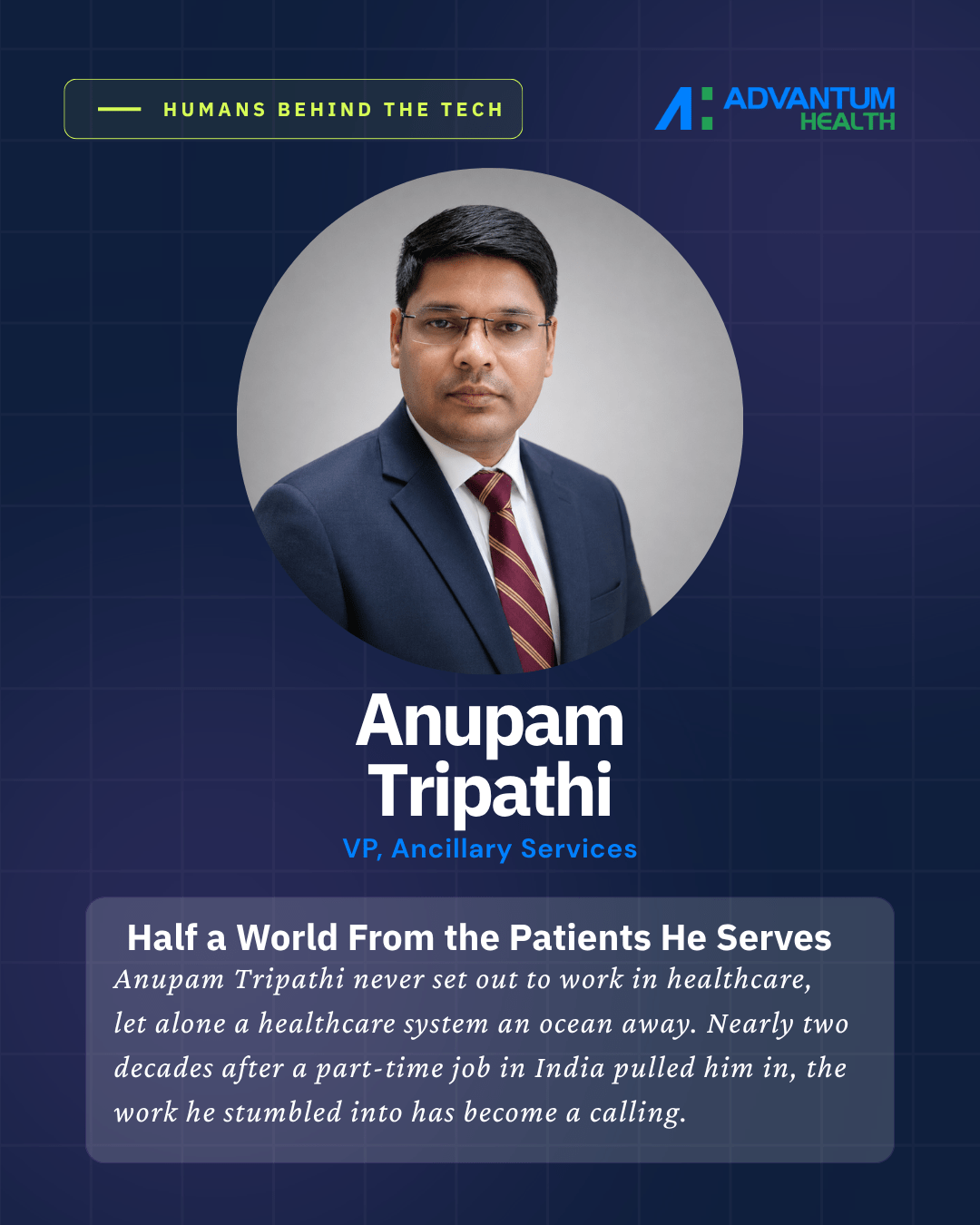
Anupam Tripathi never set out to work in healthcare, let alone a healthcare system an ocean away. Nearly two decades after a part-time job in India pulled him in, the work he stumbled into has become a calling.
In 2008, Anupam Tripathi kept a careful schedule. Two days a week, he buried himself in books, preparing for India’s demanding civil services exam, the gateway to a career in his country’s government. The other five, he worked three or four hours at a part-time job he barely understood, helping run the back office of a healthcare system on the other side of the world. It was meant to be temporary, a way to stay busy and earn a little while he chased a different future.
That future never arrived. A better one did.
What Anupam expected to be a placeholder became a fascination. The American healthcare system, which he was learning to navigate from thousands of miles away, struck him less as a job than as a puzzle. Every process raised a new question. Every payer played by different rules. Solving one problem only revealed the next. The more he learned, he says, the more he enjoyed the challenge. Somewhere in those early hours, the exam prep quietly gave way to something he had never gone looking for: a career.
The shift was not only in what he did but in how he thought. At first, Anupam focused on finishing tasks. Over time, he started asking harder questions. How does this process actually work? Why does it break? How could it be better? Healthcare, he says, did not just shape his career. It shaped the way he thinks and leads.
He credits one piece of advice that has stayed with him for years: never stop learning, because the day you stop learning is the day you stop growing. For someone who walked in knowing nothing about the industry, the words carried weight. Nearly everything he knows today came from curiosity, from asking questions, from making mistakes and paying attention to them. He now presses the same mindset on the teams he leads.
“Sometimes the best career journeys are the ones we never planned. They’re the ones we discover along the way.”
Those teams have grown alongside him. From the fundamentals of medical billing and insurance verification, Anupam moved through patient access, prior authorization, eligibility verification and accounts receivable, taking on more responsibility at each step. Today he serves as vice president of ancillary services, focused on strategic growth, automation and, above all, developing the next generation of leaders. At Advantum, where he has spent the past decade, that restless curiosity has had room to run. The company kept handing him bigger problems, and he kept saying yes. The lesson that ties it all together is a simple one, he says: sustainable success comes from balancing people, process and technology, and never at the expense of the first.
Ask him what carries him through the hardest days, and the answer is not about metrics. It is about people. Watching a team member grow into a leader. Seeing an idea become a solution that makes the work better. Colleagues describe him as calm, dependable and solution-oriented, someone more interested in the fix than the blame. Those instincts trace back home. His family, he says, instilled integrity, hard work, humility and respect, values that still guide how he leads and how he treats the people around him.
Most of Anupam’s work happens out of sight, and much of it happens an ocean away from the people it touches. The patients whose claims he helps clear are in the United States. He is in India, and he will likely never meet a single one of them. But he sees the stakes clearly. Every successful authorization, every clean claim, is one less obstacle for a patient seeking care and one less burden for a provider who would rather focus on medicine than paperwork. That, more than any title, is the point.
Outside the office, Anupam recharges by staying close to family, traveling and spending time in quiet, reflective places that reconnect him to his roots. It is the same balance he tries to create for others at work: room to grow, permission to learn and the sense that the effort matters.
Eighteen years ago, he took a part-time job in India to fund a plan that never came to pass. What he found instead was a calling, half a world from the patients it serves, and a lasting reminder that the paths we do not plan are often the ones worth following.
[Closing HBTT series tagline]