
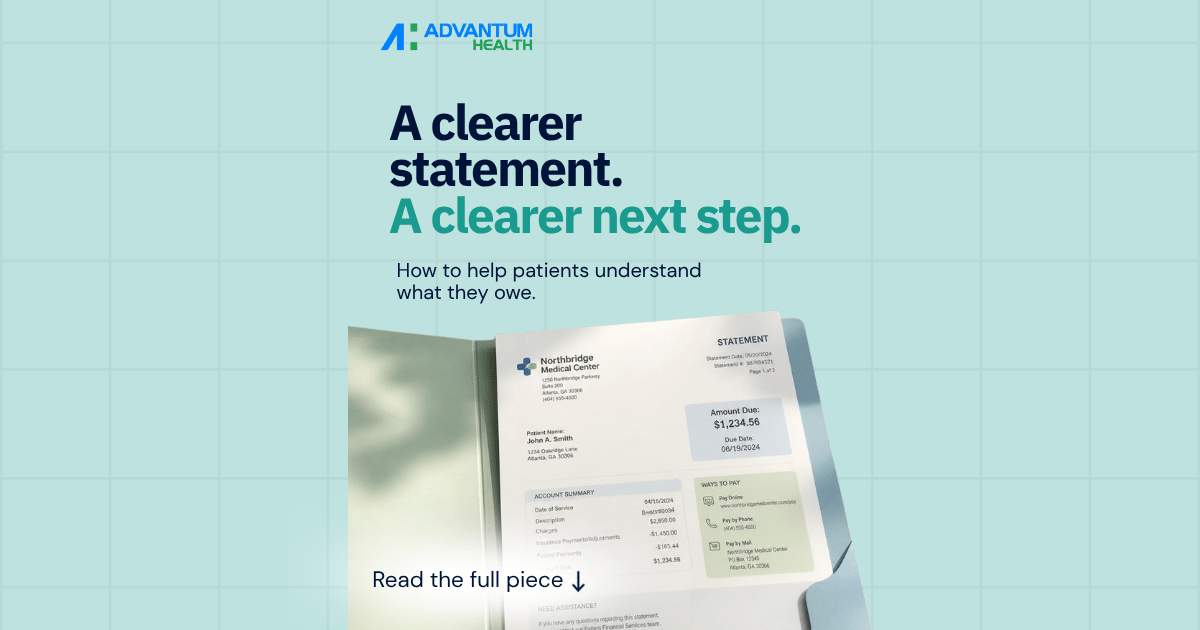
The short answer: Patient balances are now a large share of practice revenue, and affordability is not the only obstacle. In the KFF Health Care Debt Survey, adults with health care debt gave several reasons for not paying a bill in full: 67 percent lacked the money, 68 percent expected insurance to cover it and 44 percent doubted the bill was accurate. Affordability and uncertainty overlap. A practice can do little about the first and a great deal about the second. Advantum Health builds patient billing around clarity, because a bill the patient understands is a bill the patient can act on.
Why this matters: an unclear statement adds cost
Most practices treat the patient statement as a notification. Patients treat it as a claim to be verified. That gap is where self-pay revenue goes to age.
Consider what the statement actually arrives into. The patient has already received an explanation of benefits from the payer, written in a different format, using different numbers, on a different timeline. Then a statement arrives from the practice with a balance and a due date. If the two documents do not reconcile in the patient’s mind, the rational response is to wait. Waiting is free for the patient. It is expensive for the practice.
The KFF findings are worth reading carefully rather than quoting selectively. The survey asked adults with health care debt why they had not paid a bill in full, and respondents could give more than one reason. Not having enough money was the most cited. But expecting insurance to pay and doubting the amount were cited at similar rates. These are not competing explanations, and the survey does not tell us which balance failed for which reason. What it does tell us is that a meaningful share of nonpayment involves a patient who is unsure what they owe or why.
What the statement has to answer
A patient should be able to answer five questions from the statement itself, without calling anyone. Every question the statement fails to answer becomes either a phone call your staff pays for or a balance that sits.
What was this for? Date of service, provider name and a plain-language description of the service. Not a CPT code. Not an internal department abbreviation. The patient needs to recognize the visit.
What did insurance do? Billed amount, contractual adjustment, plan payment and the reason the remaining balance is the patient’s. Deductible, coinsurance and copay should be named as such. This is the section most statements handle least well, and it is the one a patient who expects insurance to cover the bill needs in order to see why it did not.
Why do I owe this specific amount? The arithmetic should be visible on the page. A balance that appears without a derivation invites a dispute even when it is correct.
What are my options? Pay in full, pay a portion, set up a plan or apply for assistance. All four on the statement, not on a portal the patient has to find.
What happens next? When the next statement arrives, what happens if nothing is paid and who to call with a question. Ambiguity about consequences does not accelerate payment. It generates anxiety and avoidance.
Why clarity belongs in the collections conversation
The argument here is about cost, not about a promised lift in collections. Each statement cycle that passes without payment carries print, postage, staff follow-up and eventually placement fees. Each avoidable call about a confusing line carries staff time. Both are measurable, and both are within the practice’s control.
Statement clarity is the cheapest place to attack both. Rewriting a template is a one-time cost. Handling the calls and repeat cycles a confusing template produces is a recurring one. Whether it also shortens your days from adjudication to first payment is an empirical question, and it is one worth measuring in your own data rather than assuming.
There is a front-end version of the same principle. Experian Health’s State of Patient Access 2026 survey found that nearly one-third of patients say paying for care is worse than a year ago, with affordability and a lack of cost clarity both cited. Providers in that same survey reported that patients at least occasionally delay or forgo care when they cannot get an estimate. An estimate given before service does not guarantee payment after it. It does mean the statement confirms something the patient already knew rather than announcing something new.
Where practices lose money on patient billing
Sending too late. A statement that arrives five or six weeks after the visit is competing with a memory the patient no longer has. Bill as soon as the payer has adjudicated, not on a month-end cycle.
Leading with the balance instead of the explanation. A large number at the top of a page with no context reads as a demand. The same number after a three-line derivation reads as a conclusion.
Burying the payment options. If the payment plan exists but the patient has to call to learn about it, most will not call. They will do nothing.
Making financial assistance opt-in. Requiring a patient to ask for help is a filter that screens out the people most likely to need it. Explain on the statement how to check eligibility for financial assistance and how to apply.
Treating every balance the same. A patient who has always paid on time and a patient with three aged balances do not need the same cadence, the same tone or the same number of touches.
Measuring only dollars collected. Collections tell you the outcome. Call volume, dispute rate, days from adjudication to first statement and days from first statement to first payment tell you why.
A checklist for practice administrators
- Read one of your own statements as a patient would. If you cannot answer all five questions above, neither can they.
- Measure days from payer adjudication to first patient statement, and set a target.
- Show the full derivation on the statement: billed, adjusted, plan paid, patient responsibility, with the responsibility type named.
- Put pay-in-full, partial pay and payment plan options on the statement, along with how to check eligibility for financial assistance and how to apply.
- Replace every code and internal abbreviation with plain language.
- Track inbound billing call volume and the top three reasons patients call, then fix the statement causing them.
- Segment follow-up by payment history and balance size rather than running one cadence for everyone.
- Confirm your good faith estimate process for uninsured and self-pay patients is running, and that any differences between an estimate and the final statement are explained in terms the patient can follow.
- Report dispute rate and days to first payment to leadership alongside net collections.
Make the statement do the work
Patient collections are usually framed as a persistence problem. More statements, more calls, earlier placement. Persistence has a ceiling, and it costs goodwill on the way up.
The clarity approach has a different cost shape. It is paid once and it does not trade patient relationships for cash. The goal is to ask once and be understood, rather than to ask repeatedly and hope.
Advantum Health connects patient billing to the rest of the cycle. Accurate patient access and eligibility work upstream determines whether the balance on the statement is right in the first place, and disciplined accounts receivable follow-up determines what happens to the balances that still age. A statement redesign on top of bad front-end data just communicates the wrong number more clearly.
Start by pulling your last 100 inbound billing calls and sorting them by reason. A revenue cycle assessment can show what those calls are costing and which fix returns the most, fastest.