
Coding & Documentation Insights, Q3 2026. Download the designed PDF edition.
The short answer: Two sets of 2027 changes put more weight on the provider’s note. The CY 2027 Medicare Physician Fee Schedule proposed rule would restructure G2211 and cut payment for additional same-day services to 50 percent. The CPT 2027 code set adds 453 changes on Jan. 1, 2027. Advantum Health’s coding team recommends practices tighten documentation now, so every code reported is supported by a note that explains why the service was necessary and what was done.
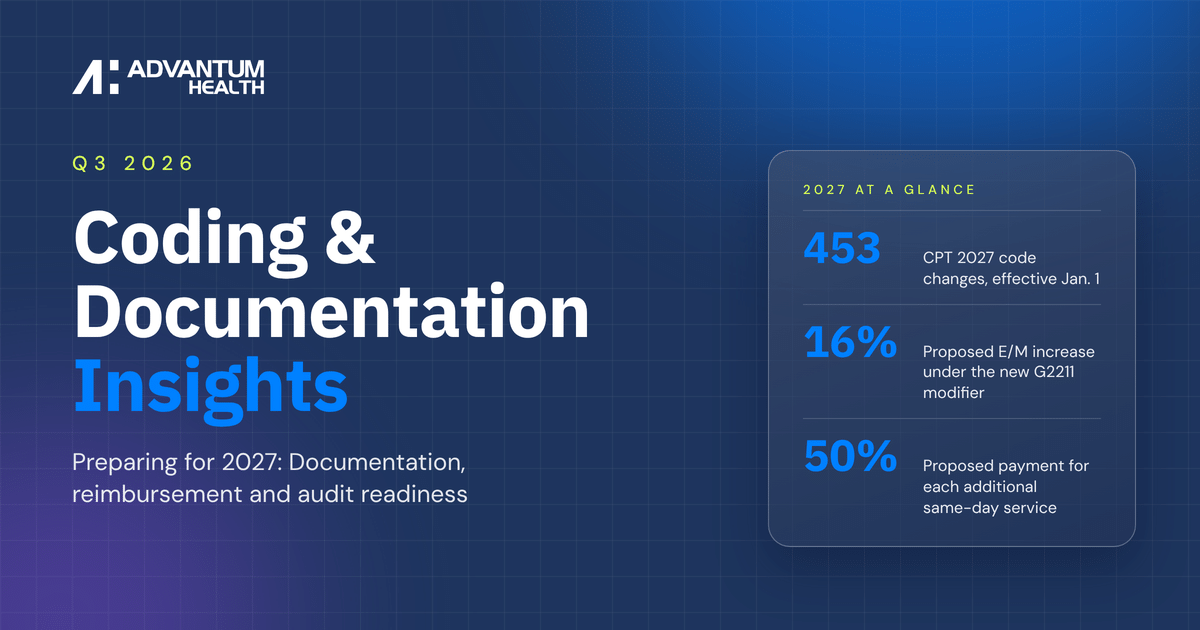
2027 at a glance
- 453 CPT 2027 code changes, effective Jan. 1, 2027.
- 16 percent proposed E/M payment increase under the new G2211 modifier.
- 50 percent proposed payment for each same-day service after the most expensive one.
- November is when the CY 2027 final rule is expected.
Why this matters: strong notes will carry more weight in 2027
Practices that document the full clinical story will be best positioned for 2027. The link between the exam room and what a payer pays keeps getting tighter.
Two forces are converging. The CY 2027 Medicare Physician Fee Schedule proposed rule would restructure G2211 and change how same-day E/M visits and procedures are paid. Both are still proposals. Both point in the same direction: payers want documentation that stands on its own, service by service.
At the same time, the CPT 2027 code set takes effect Jan. 1 with 453 changes, including updates for orthopedics and gastroenterology. No code, however well chosen, can stand in for a note that explains why a service was necessary and what was done.
The takeaway: Coders assign the codes. The provider’s note tells the patient’s story.
Payers read the note first and the code second
Many denials and audit findings stem from notes that don’t support the level of service reported, not from coding errors. A chart can carry the correct CPT and ICD-10 codes and still be denied if the narrative doesn’t justify them.
What payers look for
- Medical necessity
- Patient complexity
- Clinical decision-making
- Longitudinal care management
- Appropriate use of procedures and services
- Consistency between diagnosis, findings and service billed
What’s driving the shift
- Value-based contracts tie payment to demonstrated complexity.
- Risk adjustment audits such as RADV recoup payment when a chart doesn’t support a diagnosis.
- Payer analytics flag outlier billing patterns for manual review faster than before.
Provider self-check
- Would another clinician understand why this service was necessary?
- Is the patient’s complexity clear in the note?
- Is my medical decision-making documented?
- Does the note distinguish this visit from a routine, lower-complexity encounter?
- Could I defend this claim in writing using only what’s in the chart?
The takeaway: Good documentation looks the same as it always has. A thin note is just more likely to get caught.
G2211 update: longitudinal care still earns recognition
CMS continues to recognize the ongoing management of complex and chronic conditions. The payment mechanics may change. The principle behind G2211 does not: continuous, relationship-based care takes added work.
What’s proposed for 2027
CMS proposes replacing the flat G2211 add-on code with two modifiers, called MOD1 and MOD2 in the proposed rule.
- MOD1 would increase payment for the associated E/M visit by 16 percent at every level.
- MOD2 would apply a 32 percent increase for clinicians in a Medicare Shared Savings Program ACO or LEAD Model ACO.
The comment period closed Sept. 14, 2026, according to the Federal Register notice, and the final rule is expected in November. If finalized, the value of a longitudinal care visit would depend on a practice’s ACO participation.
What to document for chronic and complex patients
- Ongoing chronic condition management
- Treatment adjustments
- Coordination with specialists
- Review of diagnostic results
- Patient-specific barriers to care
- Reasoning linking today’s visit to the plan of care
The documentation difference
Before: “Diabetes follow-up.”
After: “Patient with poorly controlled type 2 diabetes requiring medication adjustment, review of recent lab results, discussion of adherence barriers and coordination of the ongoing management plan.”
Why it matters: The second note shows complexity and active care management.
The takeaway: What made this visit medically necessary and different from routine follow-up? Your note should answer it before an auditor asks.
Same-day E/M and procedures: separate work deserves separate documentation
Visits that pair an E/M service with a procedure, from joint injections to office-based endoscopy, remain a major focus of payer review. The question auditors ask is simple: was a significant, separately identifiable E/M service provided? It’s the question behind modifier 25 and a frequent reason these claims are audited or denied.
A proposal that raises the stakes
For procedures with 0-, 10- or 90-day global periods, the CY 2027 proposed rule would pay the most expensive same-day service in full and every other same-day service at 50 percent. It’s still a proposal, but it signals where same-day billing is headed.
Document the E/M service
- Presenting problem
- Independent assessment
- Medical decision-making
- Treatment options considered
- Why it was more than a pre-op check-in
Document the procedure
- Details and technique
- Risks discussed and consent
- Findings
- Post-procedure plan and follow-up
The documentation difference
Before: “Patient seen for knee pain. Knee injected.”
After: “Patient evaluated for worsening right knee pain despite conservative treatment. Imaging reviewed. Risks and benefits of treatment options discussed. Decision made to proceed with corticosteroid injection after evaluation and medical decision-making.”
Why it matters: The second note shows an evaluation and a decision before the injection.
The takeaway: When both halves are documented this clearly, modifier 25 reflects the note instead of covering for it.
Orthopedic spotlight: shoulder arthroscopy documentation
Arthroscopic shoulder procedures draw close payer review because of their complexity. Denials often follow operative reports that don’t clearly identify the anatomical structures treated, the pathology found, the separate procedures performed and the medical necessity for each.
Watch the bundling edits
Debridement (CPT 29822 and 29823) is often bundled into more extensive work at the same joint unless the note identifies a separate, distinct structure. When two procedures are truly distinct, modifier 59 or a more specific X modifier such as XS should be supported by the operative note, not just added to the claim.
Operative report checklist
- Findings: rotator cuff tears, labral pathology, biceps tendon abnormalities and cartilage defects.
- Procedures performed: debridement, repair, decompression, tenodesis and tenotomy.
- Medical necessity: why each procedure was performed based on surgical findings, including why a debridement became a repair or why decompression was added if the plan changed during surgery.
The takeaway: The operative report should tell a clear story from pathology identified to treatment rendered.
Gastroenterology focus: ERCP coding and documentation
ERCP is one of the more complex procedure families to code and document. Multiple possible interventions, multiple-endoscopy payment rules and sedation reporting all depend on what the note says.
- Clinical indication: choledocholithiasis, biliary obstruction, pancreatic duct abnormalities or strictures.
- Interventions: sphincterotomy, stone removal, stent placement, dilation or biopsy, and the target of each.
- Repeat procedures: why the repeat was needed, the findings and any failed prior intervention.
Report each distinct intervention
Report each distinct intervention with its own code, following CPT’s family rules. Diagnostic ERCP (43260) is included in any therapeutic ERCP in the same session, and some interventions can’t be reported together for the same lesion. Unbundling within the family is a frequent audit finding.
Sedation
Moderate sedation is no longer bundled into endoscopy codes. It’s reported separately whether the performing physician or another provider gives it, with different codes for each. Document who gave and monitored it and the intraservice time.
The documentation difference
Before: “ERCP performed.”
After: “ERCP performed for persistent biliary obstruction. Cholangiogram revealed retained common bile duct stone requiring sphincterotomy and stone extraction.”
Why it matters: The second note names the indication, the finding and each intervention.
The takeaway: Specificity supports every code reported. Make each intervention and its target easy to find.
What’s changing in CPT 2027
The AMA released the CPT 2027 code set Sept. 9, 2026. It takes effect Jan. 1, 2027, with 453 total changes: 299 new codes, 74 revised codes and 80 deleted codes.
The coding mechanics for shoulder arthroscopy and ERCP (43260-43278) are not changing for 2027. Several nearby areas are.
Orthopedics
- Sacroiliac joint fusion: 27278 and 27279 revised to better distinguish fusion types.
- Spine osteotomy (22210-22216): new guideline language clarifying reporting.
- Knee: new codes for a medial extra-articular shock absorber and an open osteochondral acellular scaffold implant; Category III code 0737T revised.
- Bone tumor ablation: new code.
- Skin cell suspension autograft: new codes replace deleted codes 15011-15018.
Gastroenterology and digestive system
- Endoscopic submucosal dissection: two new codes for the upper and lower GI tract.
- Diaphragm repair: new code for thoracoscopic plication; 39545 revised to clarify the open approach.
- Congenital duodenal obstruction repair: new codes for open and laparoscopic repair; 44180 revised.
The takeaway: Final numbers for new codes are in the CPT 2027 codebook. Cross-check orthopedic and GI templates against it before Jan. 1.
Audit readiness: audits now start with your patterns
Audits once focused on individual claims. Many payer reviews now begin with provider trends.
Trends that draw review
- Higher-than-expected level-of-service utilization
- Frequent modifier use
- Rising procedure volume
- Unusual diagnosis patterns
- Reimbursement above peers
- HCC recapture rates well above specialty peers without matching comorbidity documentation
Being above average isn’t wrong. The documentation has to explain why your patients or your practice differ. A coding audit shows where your patterns stand before a payer looks.
Questions to consider
- E/M services: Would your patient population explain your E/M level distribution against specialty peers?
- Chronic disease: Does each problem list item have a status and a plan? A condition with neither is a common reason auditors recoup an HCC.
- Procedures: Are operative and procedure notes complete and specific?
- Medical necessity: Would another provider agree with the treatment decision based on the note alone?
Compliance corner: medical necessity
Denials often happen not because a service wasn’t performed, but because the note didn’t establish why it was needed. The standard is the same for a commercial payer audit, a Medicare RADV review or an internal quality check. Document:
- Symptoms and severity
- Functional impact
- Previous treatment failures
- Clinical rationale
- Treatment plan
- Why lesser interventions weren’t chosen
Providers often know these factors clinically but forget to include them in the note.
The takeaway: If it isn’t documented, it can’t be defended.
Your 2027 readiness checklist: ten steps to take this quarter
Use this checklist to get ahead of the final rule and the new code set.
- Review documentation supporting chronic disease management.
- Confirm same-day E/M and procedure notes separate the two services.
- Verify operative reports describe all pathology identified and treated.
- Strengthen documentation of medical necessity.
- Review high-volume procedures for completeness and specificity.
- Monitor denial trends and provider-level audit findings.
- Compare provider E/M and HCC patterns to specialty peers at least quarterly.
- Track the CY 2027 final rule for G2211 and same-day payment policy.
- Cross-check orthopedic and GI templates against the CPT 2027 codebook.
- Consult coding or CDI when documentation questions arise.
The bottom line: Strong documentation supports accurate coding and payment, and it reflects the complexity of the care you provide every day. None of this requires changing how you practice medicine. It requires a note that captures what you already know clinically.
Frequently asked questions
What is changing with G2211 in 2027?
The CY 2027 proposed rule would replace the G2211 add-on code with two modifiers. MOD1 would add 16 percent to the associated E/M visit. MOD2 would add 32 percent for clinicians in a Medicare Shared Savings Program ACO or LEAD Model ACO. The final rule is expected in November 2026.
How would same-day E/M and procedure payment change?
For procedures with 0-, 10- or 90-day global periods, CMS proposes paying the most expensive same-day service at 100 percent and each additional same-day service at 50 percent.
When does CPT 2027 take effect?
Jan. 1, 2027. The AMA released the code set Sept. 9, 2026, with 453 changes: 299 new, 74 revised and 80 deleted codes.
How can a practice prepare?
Start with documentation. Confirm notes support medical necessity, separate same-day services, describe every intervention and explain E/M and HCC patterns that differ from specialty peers.
Support for the work ahead
Advantum’s coding team and physician advisors work alongside practices preparing for the final rule and the new code set.
- Coding audits: a review of your E/M levels, modifier use and HCC capture against specialty peers.
- Provider documentation education: specialty-specific sessions built around your own audit findings, from same-day visits to operative reports.
- Medical coding and billing: certified coders current on CPT 2027 who apply payer rules claim by claim.
- Denial management: root-cause analysis of denial trends, so documentation gaps are fixed at the source.
Ready for 2027? Strengthen documentation. Protect revenue.
Whether you’re preparing for the CY 2027 final rule, updating templates for CPT 2027 or tightening documentation before your next audit, Advantum’s coding leadership and physician advisors help align documentation with payer expectations before revenue is at risk.
Advantum clients: Contact your Customer Success Manager to schedule a documentation review or suggest a topic for a future issue.
New to Advantum? Schedule a conversation with our coding team about a documentation review.
Download the Q3 2026 Coding & Documentation Insights PDF
Sources: CMS, Calendar Year (CY) 2027 Medicare Physician Fee Schedule Proposed Rule fact sheet, July 14, 2026 (cms.gov); AMA, “AMA releases CPT 2027 code set,” Sept. 9, 2026 (ama-assn.org); AMA CPT Editorial Panel Summary of Panel Actions, February, May and September 2025. Items describing the CY 2027 proposed rule reflect proposed, not final, policy. This article is general education and does not replace the full text of the proposed or final rule, CMS guidance or a formal coding audit.